
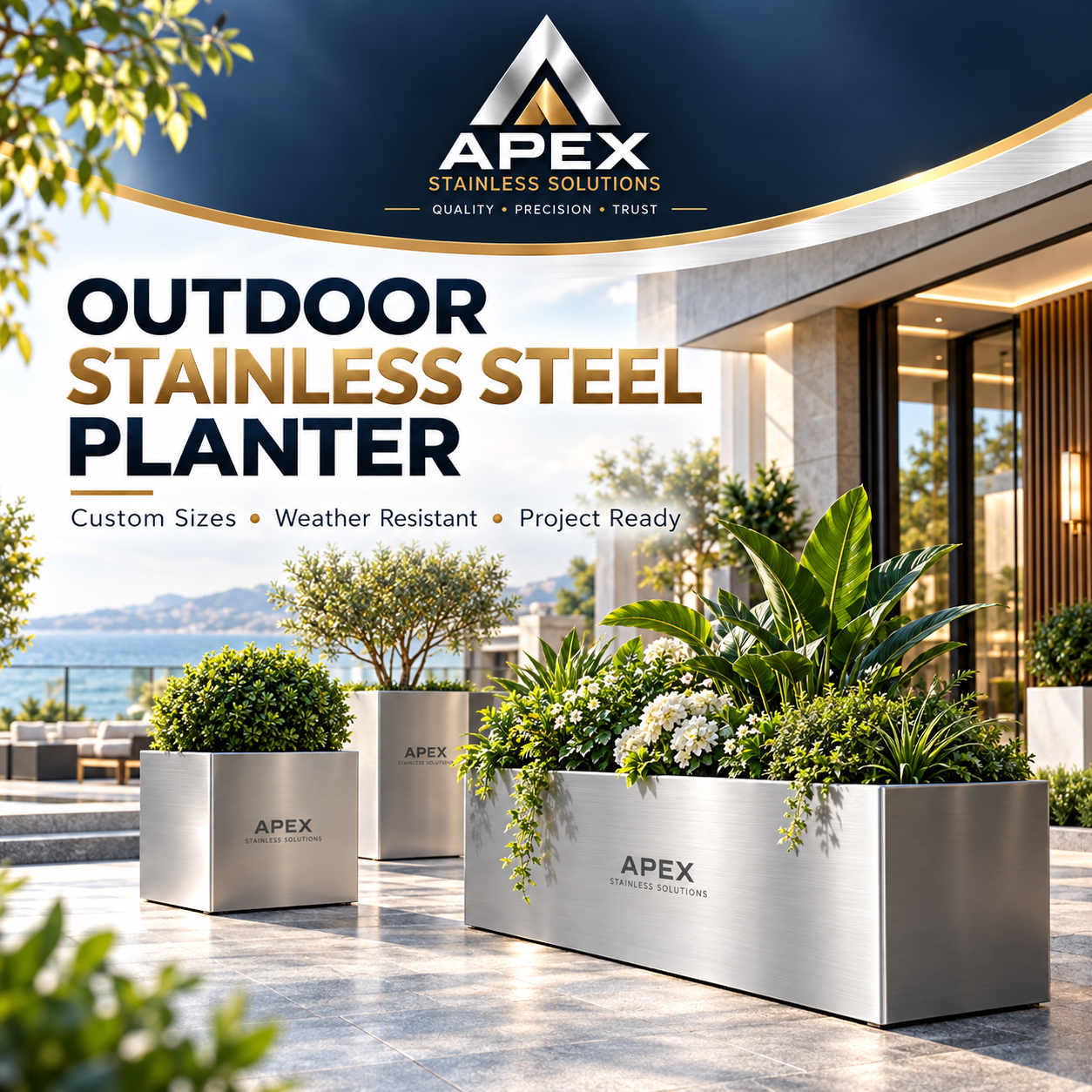
Quick answer: A custom outdoor stainless steel planter is fabricated to fit a specific landscape layout instead of a fixed retail size. For U.S. commercial, hospitality, multifamily, and residential projects, the planter dimensions, finish, drainage, liner, base details, placement conditions, and shipping plan should be confirmed before production.
This guide is for landscape architects, designers, contractors, developers, dealers, and property teams sourcing project-ready planters. It explains what to specify, what to measure, and what to send when requesting a quotation for a Custom Outdoor Stainless Steel Planter.
What is a custom outdoor stainless steel planter?
A custom outdoor stainless steel planter is a fabricated metal planting container made to an approved size, shape, finish, and planting configuration. Rectangular, square, divider, corner, and project-specific forms can be evaluated. Depending on the application, the design may also include drainage holes, a removable inner liner, hidden feet or wheels, a custom logo, and coordinated planter sets.
Why project buyers specify stainless steel planters
- Made-to-fit dimensions: length, width, height, and shape can follow the landscape plan, walkway, entrance, terrace, or seating layout.
- Clean architectural appearance: crisp edges and coordinated finishes suit hotels, restaurants, offices, retail centers, and modern residential spaces.
- Repeatable project packages: one approved drawing and finish sample can be used across multiple locations or unit types.
- Flexible visual zoning: long rectangular planters can help define circulation, dining, privacy, and landscape areas without permanent walls.
- Configurable details: drainage, liners, feet, wheels, branding, and matching sets can be reviewed for the intended use.
Specification checklist for quotation
Send the following information in both inches and millimeters when possible:
- Project photo, landscape plan, elevation, or reference style
- Overall length, width, height, quantity, and required shape
- Installation location and application, such as rooftop, poolside, hotel entrance, café terrace, walkway, or indoor lobby
- Preferred stainless grade and the local exposure conditions
- Finish or color reference, such as brushed silver, matte black, champagne gold, bronze brown, or a custom finish
- Drainage-hole locations and whether an inner liner is required
- Base detail, including hidden feet, wheels, leveling, anchoring, or floor-protection requirements
- Planting depth, irrigation concept, and any soil or load limitations
- Custom logo, labeling, and matching-set requirements
- Delivery city, ZIP code, target date, and site-access restrictions
Final dimensions should be checked against finished site conditions. Doorways, elevators, corridors, loading docks, crane access, finished paving, waterproofing, and maintenance clearance can all affect the practical planter size and delivery plan.
Drainage, liners, and planting system coordination
Drainage should be designed together with the planting and irrigation plan. Confirm the number and position of drainage holes, the need for an inner liner, overflow control, floor or roof protection, and how water will be directed away from occupied areas. Do not assume a decorative planter is watertight or suitable for direct placement over a waterproof roof assembly unless that requirement is shown on the approved drawing.
The landscape contractor should also confirm planting depth, root volume, soil system, irrigation access, and long-term maintenance. These items determine the usable internal space and may change the outer dimensions.
Selecting a finish for outdoor exposure
The finish should match both the design intent and the environment. Brushed stainless steel provides a neutral architectural look, while matte black, champagne gold, bronze brown, mirror, powder-coated, or other custom finishes can be evaluated from a reference sample. Color appearance can vary under sunlight, so approve a physical or documented finish standard before bulk production.
Tell the supplier if the site is near the coast, exposed to pool chemicals, de-icing salts, industrial pollution, or frequent irrigation spray. The stainless grade, surface treatment, fabrication details, and maintenance plan should be selected for the actual exposure rather than appearance alone.
Placement, stability, and structural planning
A large planter becomes significantly heavier after the liner, soil, water, and plants are added. Rooftops, balconies, raised decks, and suspended slabs may require review by the project engineer. Confirm wind exposure, tip resistance, anchoring, drainage routing, and protection of the finished floor. Hidden wheels can assist repositioning in suitable applications, but mobility and locking requirements must be confirmed before fabrication.
Packaging and shipping for multi-unit projects
For international delivery, confirm whether each planter will ship fully welded and assembled, how exposed surfaces will be protected, and how units will be labeled by area or floor. Large welded planters can use substantial container space, so overall dimensions and quantities should be finalized early. A packing plan with protective film, corner protection, moisture control, crate or pallet details, and unloading instructions helps reduce handling damage.
Questions U.S. buyers should ask before approving production
- Are the overall dimensions and planting depth shown on the approved drawing?
- Which stainless grade and finish are included in the quotation?
- Where are the drainage holes, liner, feet, wheels, or anchors located?
- Will the planter arrive fully assembled, and can it pass through the planned access route?
- How are visible surfaces and corners protected during shipment?
- Are finish samples, logo artwork, labeling, and quantity schedules approved?
Frequently asked questions
Can stainless steel planters be made in custom sizes and shapes?
Yes. Rectangular, square, divider, corner, and other project-specific forms can be evaluated from a sketch, plan, or dimensioned drawing. Final feasibility is confirmed during drawing review.
Can drainage holes and inner liners be included?
Yes. Drainage holes and inner liners can be specified when the planting system, irrigation method, and installation surface are known. Their size and position should be approved before production.
Are custom finishes and logos available?
Yes. Brushed, mirror, powder-coated, colored, and other project finishes can be reviewed, along with custom logos and coordinated planter sets. Approve the finish reference and logo artwork before bulk production.
What information is needed for a fast quotation?
Provide a project photo or reference, required dimensions, finish, quantity, application, drainage and liner requirements, delivery location, and target date. A simple dimensioned sketch is usually more useful than a description alone.
Request a project quotation
For an accurate quotation, send your layout or sketch, length, width, height, finish reference, quantity, drainage details, application scene, delivery city, and required date. Contact APEX to review a custom stainless steel planter package for your project.
How this guide is verified
Product details in this guide reflect APEX configurable manufacturing options. Final stainless grade, dimensions, finish, lighting, accessories, packaging, and delivery terms are confirmed in the approved quotation and production drawing.
Reviewed by APEX Stainless Solutions · Updated September 11, 2026