
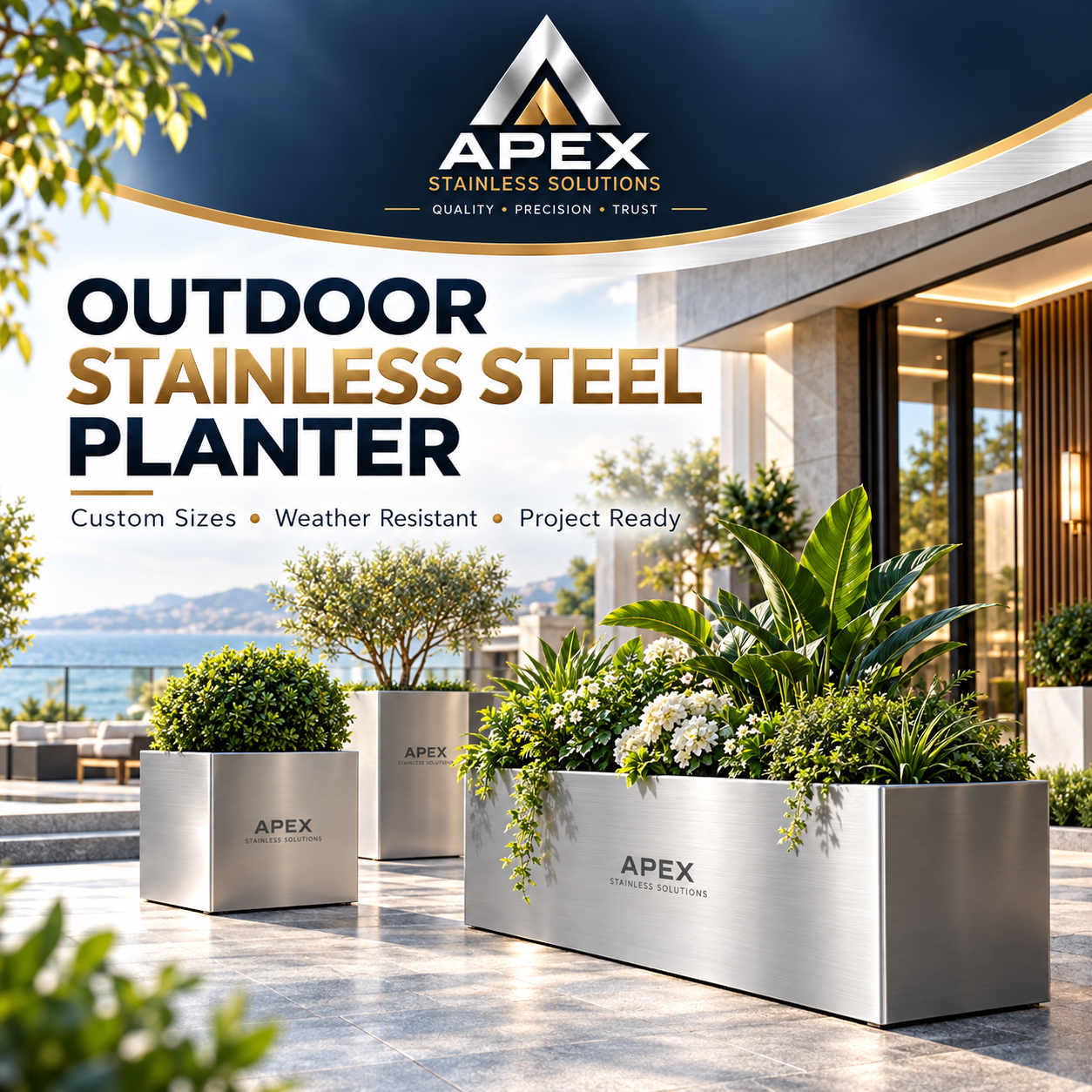
Quick answer: For builders, developers, kitchen dealers, and outdoor kitchen dealers, custom outdoor stainless steel planters are project-manufactured containers sized and finished to coordinate with architecture, landscaping, and outdoor kitchen packages. A reliable global order should define dimensions, stainless grade, finish, drainage, liner, base, quantity, installation conditions, packaging, destination, and approval steps before production.
This guide explains how global trade buyers can source a Custom Outdoor Stainless Steel Planter for residential, hospitality, commercial, and mixed-use projects. It focuses on the decisions that affect quotation accuracy, repeatability, installation, and long-term project value.
Who is this sourcing guide for?
- Builders: coordinate planter dimensions, drainage, access routes, paving, waterproofing, anchoring, and installation sequencing with site work.
- Developers: create a repeatable specification across buildings, phases, locations, or unit types while controlling finish consistency and total project cost.
- Kitchen dealers: expand a cabinetry package with coordinated metal planters for patios, terraces, balconies, and indoor-outdoor living spaces.
- Outdoor kitchen dealers: combine cabinetry, counters, appliances, storage, and planters into a complete outdoor environment with one coordinated visual language.
Why global project buyers choose custom stainless steel planters
- Project-specific sizing: length, width, height, shape, and planting depth can follow the approved plan instead of a fixed retail format.
- Architectural coordination: finishes can be reviewed alongside stainless steel cabinets, counters, screens, gates, or other metalwork.
- Repeatable packages: an approved drawing, finish reference, and labeling schedule can support multi-unit and multi-location projects.
- Space planning: rectangular and divider planters can define dining, circulation, privacy, entrance, and landscape zones without permanent walls.
- Configurable details: drainage holes, liners, hidden feet, wheels, anchors, logos, and unit labels can be evaluated for the application.
What should be specified before requesting a quotation?
A useful request for quotation should include the following information. Provide dimensions in both millimeters and inches when possible:
- Overall length, width, height, planting depth, shape, and quantity
- Project type, installation location, and indoor or outdoor application
- Site exposure, including coastal air, pool chemicals, de-icing salts, irrigation spray, humidity, and industrial pollution
- Preferred stainless grade and required finish or color reference
- Drainage-hole size and position, inner liner, overflow, and irrigation concept
- Base detail, including hidden feet, leveling, wheels, anchors, or floor protection
- Expected soil, water, plant, wind, and movement conditions
- Logo, private-label, model-number, and area-labeling requirements
- Project drawings, reference photos, finish samples, and approval procedure
- Delivery country, city, postal code, unloading conditions, and target date
Final dimensions should be checked against finished site conditions and the complete delivery route. Doorways, elevators, corridors, loading docks, crane access, paving levels, waterproofing, and maintenance clearance can determine the practical size of each planter.
Should an outdoor planter use 304 or 316 stainless steel?
Direct answer: 304 stainless steel is commonly considered for many general architectural applications, while 316 stainless steel is often evaluated for coastal or chloride-exposed environments. The correct grade depends on the actual site, surface finish, fabrication details, cleaning plan, and project requirements.
Do not select the grade by appearance alone. Tell the supplier if the planter will be near salt air, a swimming pool, de-icing salts, fertilizer, frequent irrigation, or industrial contaminants. The buyer, designer, and supplier should confirm the material and maintenance expectations before approving production.
How planters fit an outdoor kitchen dealer package
Custom planters can extend an outdoor kitchen beyond the cooking line and help create a complete entertaining zone. Dealers can coordinate the planter package with cabinet modules, bar islands, counters, privacy screens, and seating areas.
- Align planter lengths with cabinet modules, walls, or paving joints.
- Approve planter and cabinet finishes from the same documented reference or physical sample.
- Keep planting, drainage, and irrigation separate from electrical, gas, appliance, and cabinet service zones.
- Confirm heat clearances around grills and other appliances with the relevant appliance and project requirements.
- Plan maintenance access so plants, liners, drainage points, and cabinet services remain reachable.
- Review wheels, anchors, or leveling feet details based on whether the layout is fixed or seasonal.
Dealer, OEM, and multi-project purchasing options
Kitchen dealers and outdoor kitchen dealers often need more than a one-time custom unit. When discussing a dealer or OEM program, identify which details must remain standard and which can change by order. A controlled product family may use fixed construction and finish standards with adjustable lengths, heights, drainage positions, logos, and labels.
Developers can use a similar approach for phased projects. Approve a master specification, finish reference, drawing format, model code, and packaging standard, then issue quantities by building, area, phase, or destination. Ask the manufacturer to confirm feasibility, minimum quantities, sample policy, drawing approvals, production milestones, and replacement-part procedures in writing.
How to compare custom planter suppliers
Compare quotations line by line rather than comparing only the total price. Check whether each offer includes the same scope:
- Confirmed stainless grade, sheet specification, visible finish, and color reference
- Overall dimensions, internal planting space, seams, edges, corners, and base construction
- Drainage, liner, feet, wheels, anchors, logos, and accessories
- Shop drawings, samples, inspection records, and approval responsibilities
- Protective film, corner protection, moisture control, pallets or crates, and unit labeling
- Production lead time, shipping term, freight scope, destination charges, and unloading responsibility
- Warranty scope, spare parts, touch-up materials, and process for reporting transit damage
A low initial price can become expensive if the quotation excludes packaging, finish approval, engineering coordination, destination costs, or site handling. Ask for a written list of inclusions, exclusions, assumptions, and buyer-supplied information.
Global shipping and installation planning
Large welded planters can occupy substantial shipping volume, so dimensions and quantities should be frozen early. Confirm whether units will ship fully assembled, nested where feasible, or packed individually. Visible surfaces need suitable protection, and every package should be identifiable by project, building, floor, area, or model when the order contains multiple types.
Before shipment, confirm the commercial terms, packing list, product labels, delivery address, unloading equipment, site storage, and installation sequence. The receiving team should inspect packages and visible surfaces promptly and record any damage according to the agreed process.
Recommended procurement process
- Define the application: identify the project type, target users, environment, and design intent.
- Send the RFQ package: include dimensions, quantities, drawings, finishes, drainage, destination, and schedule.
- Review feasibility and quotation: compare scope, assumptions, commercial terms, and requested options.
- Approve drawings and samples: verify dimensions, material, finish, construction, labels, and interfaces.
- Confirm the order: freeze the quantity schedule, packaging plan, milestones, and delivery terms.
- Inspect before shipment: review agreed quality records, labeling, protection, and packing details.
- Receive and install: inspect on arrival, follow the approved handling plan, and coordinate planting and drainage with the landscape team.
Common mistakes to avoid
- Ordering from a concept image without a dimensioned drawing
- Choosing stainless grade and finish without describing the actual environment
- Assuming a decorative planter is automatically watertight
- Ignoring soil, water, plant, wind, slab, and transport loads
- Placing drainage above finished roofs or occupied areas without a water-management plan
- Failing to check doors, elevators, corridors, cranes, and unloading equipment
- Approving color from a screen image instead of a controlled finish reference
- Comparing quotations that include different packaging, freight, or accessory scopes
Frequently asked questions
Can outdoor stainless steel planters be made to custom sizes?
Yes. Rectangular, square, divider, corner, and project-specific forms can be evaluated from a sketch, layout, or dimensioned drawing. Final feasibility is confirmed during drawing review.
Can planters match stainless steel outdoor kitchen cabinets?
Yes. The planter and cabinetry can be coordinated through an approved finish reference, module dimensions, and project drawing. Because different shapes and lighting conditions affect appearance, approve the documented finish before production.
Are drainage holes and removable liners available?
They can be specified when the planting system, irrigation method, installation surface, and maintenance plan are known. Their size, number, position, and access should be shown on the approved drawing.
Can dealers request logos or private labeling?
Custom logos, labels, model codes, and coordinated product sets can be evaluated. Send the artwork, placement, finish, quantity, and packaging requirements with the RFQ.
Can large project orders be produced in phases?
Phased production can be discussed when the buyer provides the total forecast, release quantities, destination schedule, approved specification, and finish-control requirements. Commercial terms and capacity should be confirmed for each project.
What is needed for an accurate global quotation?
Provide a dimensioned drawing or sketch, quantity, stainless grade or exposure conditions, finish reference, drainage and liner details, base requirements, logo needs, delivery destination, target date, and site-access information.
Request a global project quotation
Send your drawings, dimensions, finish reference, quantity, application, delivery country, and required date. Review the detailed custom planter specification guide, or contact APEX to discuss a planter package for your building, development, kitchen dealership, or outdoor kitchen project.
How this guide is verified
Product details in this guide reflect APEX configurable manufacturing options. Final stainless grade, dimensions, finish, lighting, accessories, packaging, and delivery terms are confirmed in the approved quotation and production drawing.
Reviewed by APEX Stainless Solutions · Updated September 11, 2026